Decoding Transformer Nameplates: A Guide for Importers

Decoding Transformer Nameplates: A Guide for Importers
Understanding Your Power Transformer: A Nameplate Decoder for Importers
When importing power transformers, especially from international markets like South Korea, one of the most critical pieces of documentation you'll encounter is the transformer nameplate. This small, often metal, plate is densely packed with vital information about the transformer’s specifications, capabilities, and safety ratings. For importers, understanding how to read and interpret this nameplate is not just about technical knowledge; it’s crucial for ensuring compliance, proper installation, safe operation, and efficient integration into your electrical infrastructure. This guide, tailored for those engaging with Korean power transformer exports adhering to international standards like IEC 60076, KEPCO, and IEEE C57, will demystify the transformer nameplate.
Why is the Transformer Nameplate So Important?
The nameplate is the transformer’s identity card. It provides essential data that dictates:
- Performance Characteristics: Power rating, voltage levels, frequency.
- Technical Specifications: Impedance, cooling method, winding details.
- Safety and Compliance: Standards followed, serial number, manufacturer details.
- Operational Parameters: Tap settings, connection type.
- Maintenance and Troubleshooting: Date of manufacture, weight.
Accurately interpreting this information ensures you select the right transformer for your application, avoid costly mistakes during installation, and maintain operational safety and efficiency. For importers, especially those new to the process or dealing with international manufacturers, a clear understanding of these details is paramount.
Key Information Found on a Transformer Nameplate (IEC 60076 Focus)
While specific layouts can vary between manufacturers and standards (IEC 60076, IEEE C57, KEPCO), several core pieces of information are universally present. Let's break down the most common elements:
1. Manufacturer and Model Information
- Manufacturer Name: Usually prominently displayed. For Korean exports, this might be a leading manufacturer known for quality and adherence to standards.
- Model/Type Designation: A specific code identifying the transformer model.
- Serial Number: A unique identifier for each manufactured unit. Essential for tracking, warranty, and service.
- Date of Manufacture: Indicates when the transformer was produced. Important for age assessment and warranty.
2. Power Rating (kVA or MVA)
This is perhaps the most fundamental specification. It indicates the transformer's apparent power handling capacity.
- Rated Power: Expressed in kilovolt-amperes (kVA) for smaller units or megavolt-amperes (MVA) for larger power transformers. This is the maximum power the transformer can continuously supply without exceeding temperature limits.
3. Voltage Ratings
This specifies the voltage levels the transformer is designed to work with.
- Primary Voltage (High Voltage - HV): The input voltage.
- Secondary Voltage (Low Voltage - LV): The output voltage.
- Standard Voltage Designations: Often indicated by symbols like 'kV' (kilovolts) or 'V' (volts). For example, a rating might be 22.9 kV / 127 V.
- Taps: Many transformers have taps on the windings (usually the HV winding) to allow for small adjustments to the voltage ratio. The nameplate will show the nominal voltage and the range of tap settings (e.g., 22.9 kV ±2.5%/5%). This is crucial for voltage regulation.
4. Frequency (Hz)
Indicates the AC frequency the transformer is designed to operate at.
- Rated Frequency: Typically 50 Hz or 60 Hz, depending on the region of application (e.g., 60 Hz is common in North America, 50 Hz in Europe and many Asian countries). Ensure this matches your local grid requirements.
5. Impedance (%)
Transformer impedance is a critical parameter affecting voltage regulation, fault current levels, and paralleling capability.
- Per-unit Impedance (%Z): Expressed as a percentage, it represents the voltage drop within the transformer at full load. Lower impedance generally means better voltage regulation but higher fault currents. Higher impedance limits fault currents but can lead to poorer voltage regulation. The specific value is crucial for system design.
6. Cooling Method (Cooling Code)
Transformers generate heat due to losses. The cooling method ensures this heat is dissipated effectively to prevent overheating and damage.
- Standard Codes (e.g., IEC 60076-1): Codes like ONAN, ONAF, OFAF, etc., describe the cooling medium (Oil/Water/Air) and the mode of circulation (Natural/Forced).
- ONAN (Oil Natural Air Natural): The most common method for many distribution and small power transformers, relying on natural convection.
- ONAF (Oil Natural Air Forced): Uses fans to enhance air cooling.
- OFAF (Oil Forced Air Forced): Uses pumps for oil circulation and fans for air cooling.
- Other Codes: Might indicate water cooling (W) or combinations.
Understanding the cooling method is vital for ensuring adequate ventilation and specifying any auxiliary equipment (like fans or pumps) if needed.
7. Winding Connections (Vector Group)
This specifies how the primary and secondary windings are interconnected and the phase relationship between the primary and secondary voltages.
- Standard Designations (e.g., Dyn11, Yyn0): These codes, often derived from IEC standards, provide crucial information. The first letter (e.g., D for Delta, Y for Star/Wye) indicates the HV winding connection, the second (d or y) the LV winding connection. The number (e.g., 11) indicates the phase displacement of the LV neutral relative to the HV neutral (in multiples of 30 degrees).
- Importance: Incorrect vector group selection can lead to incorrect voltage phasing, circulating currents, or even damage to the transformer and connected equipment. It’s especially critical for three-phase transformers and systems.
8. Insulation Level
Specifies the ability of the insulation system to withstand transient overvoltages, such as those caused by lightning or switching surges.
- BIL (Basic Impulse Level): Often specified in kV peak, this is a key parameter for insulation coordination, particularly important for IEEE C57 compliance.
- Test Voltages: May also list values for power frequency withstand voltage and induced voltage tests.
9. Other Important Data
- Weight: Total weight and sometimes weight of oil. Important for transport, foundation design, and handling.
- Dimensions: Though less common on the nameplate itself, can sometimes be referenced or provided in accompanying documentation.
- Standard Compliance: Often explicitly states compliance with IEC 60076, KEPCO standards, IEEE C57, or other relevant national/international norms.
- Terminal Arrangement: Sometimes indicated to show the physical layout of connection points.
- Enclosure Type: Can indicate the degree of protection (e.g., IP rating).
Navigating Korean Standards (KEPCO) and International Equivalents (IEC, IEEE)
Korean power transformer manufacturers like those supplying KEPCO (Korea Electric Power Corporation) often build transformers to stringent national standards that are closely aligned with or based on international standards such as IEC 60076. When importing, you might see references to both.
- IEC 60076: A comprehensive series of international standards for power transformers, covering aspects from general requirements, loading, insulation levels, to noise levels.
- IEEE C57: The primary set of standards for transformers in North America, also widely respected globally.
- KEPCO Standards: KEPCO's internal specifications are often very detailed and ensure high reliability and performance for the Korean grid. Transformers built for KEPCO are typically of very high quality and robust design.
As an importer, ensure the nameplate clearly indicates compliance with the standards required for your specific market or project. If a transformer is specified for KEPCO, it's usually a good indicator of its quality and adherence to rigorous specifications, making it suitable for export markets as well.
Tips for Importers When Reading Nameplates
- Verify Against Documentation: Always cross-reference the nameplate information with the manufacturer's datasheets, test reports, and purchase order specifications.
- Understand Units: Be clear about units (kVA vs. MVA, kV vs. V, Hz).
- Check for Ambiguity: If any information is unclear or missing, contact the manufacturer immediately for clarification. Don't make assumptions.
- Consult Experts: If you are unsure about any technical specification, consult with your engineering team or a qualified electrical engineer.
- Context Matters: The importance of certain parameters (like impedance or tap settings) depends heavily on your specific application and the electrical system the transformer will be connected to.
Conclusion
The transformer nameplate is an indispensable tool for any importer. By understanding the meaning behind each marking – from power rating and voltage levels to cooling methods and vector groups – you can ensure a smooth procurement process, correct installation, and safe, reliable operation of your power transformer. Partnering with reputable Korean manufacturers ensures you receive equipment built to international standards, offering peace of mind and long-term value for your investment.
Recommended Products
Discover related products from our store
Read Next
Continue reading related articles curated for you.

Transformer Vector Group Explained: A Buyer's Guide
Demystify transformer vector groups! Learn what they are, how to read notation (like Dyn11), and why they're crucial for international buyers ensuring grid compatibility & safety.
Read
Power vs. Distribution Transformers: Key Differences Explained
Explore the critical differences between power and distribution transformers, their roles in the electrical grid, key specifications, and governing standards like IEC 60076.
Read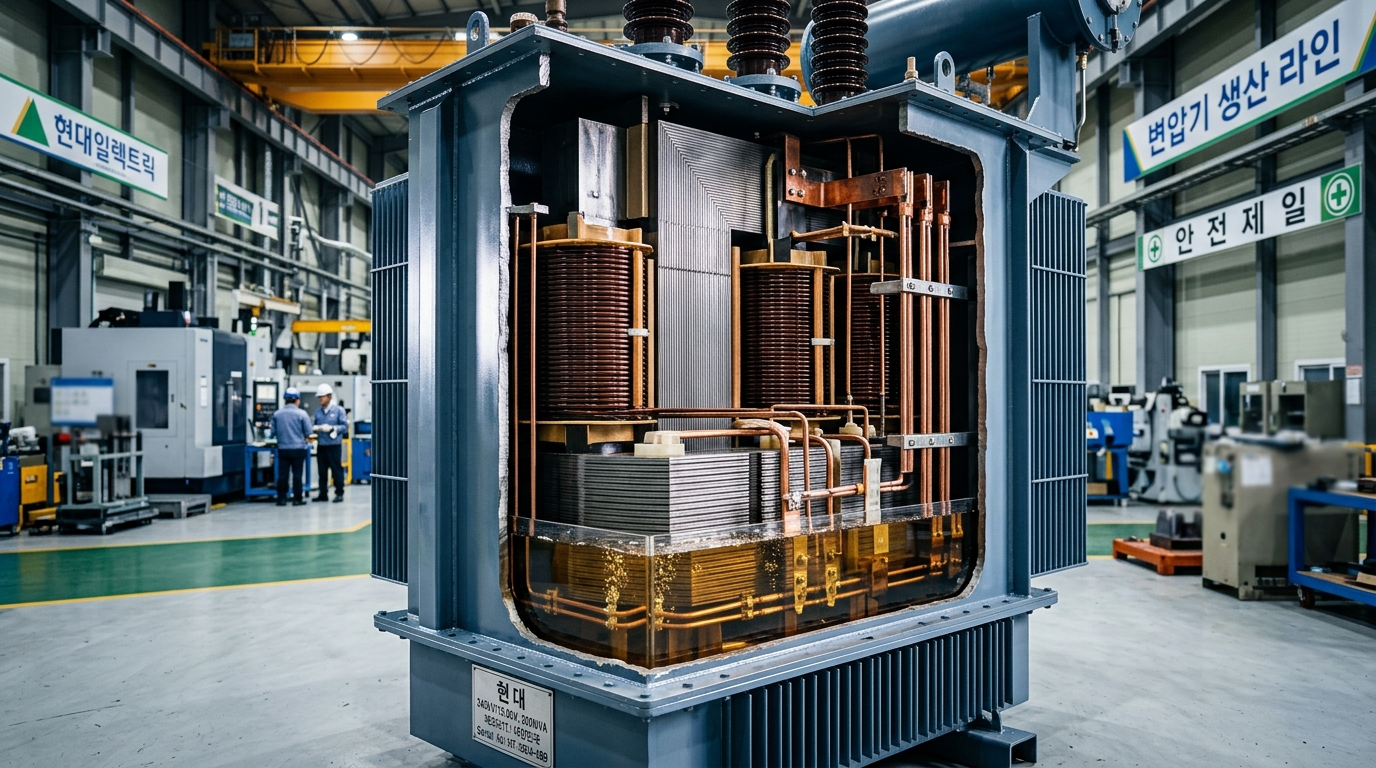
Inside a Transformer: Key Components & How They Work Together
Explore the critical components inside a power transformer, from the core to cooling systems, and discover how they synergize to ensure reliable, efficient power delivery. Learn about adherence to IEC 60076 and IEEE C57 standards for global markets.
Read